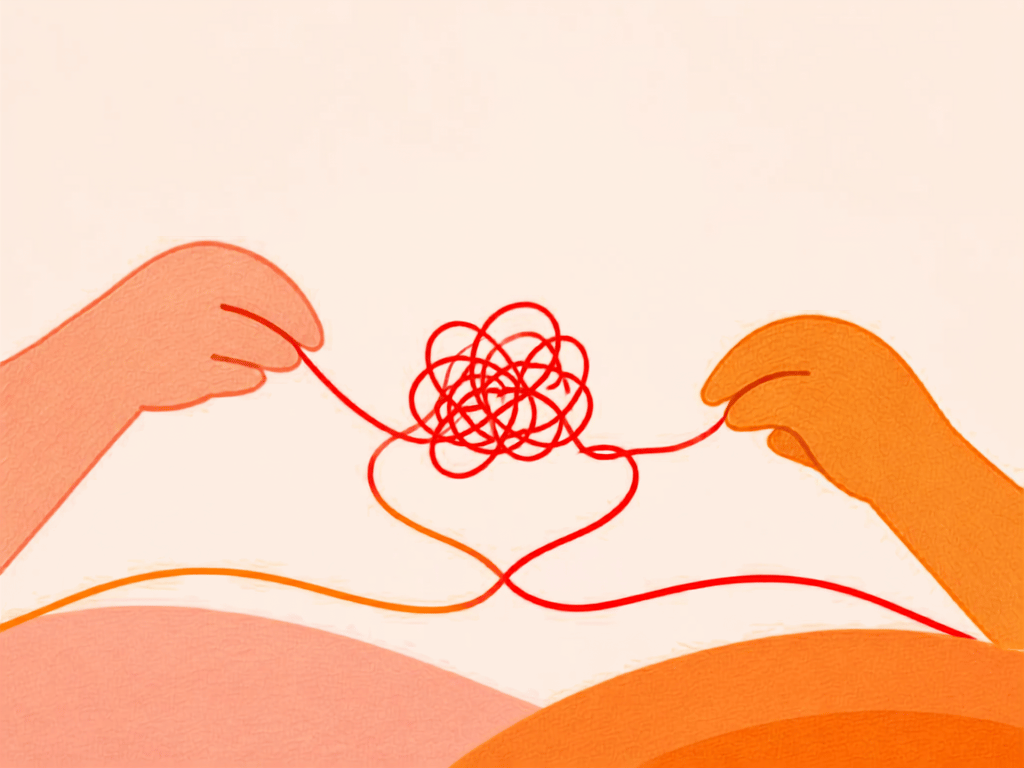
Couples do not always come to counseling because their relationship is on the verge of ending.
Some come because they notice they are having the same argument again and again. Others still care deeply about each other but find that conversations increasingly end in defensiveness, anger, or withdrawal. Some couples arrive after a major change — getting married, becoming parents, moving, experiencing a loss, or discovering a betrayal — and realize that the ways they once relied on each other no longer seem to be enough.
In situations like these, couples counseling is not simply about deciding who is right or wrong, or teaching two people how to “communicate better.” More often, the work involves looking closely at what is happening between them.
One person may try harder to talk when they feel unheard, while the other becomes quieter because they feel criticized or overwhelmed. The more one withdraws, the more abandoned the other may feel, and the more urgently they seek a response. Over time, both people can become caught in a pattern that neither of them wants, but neither quite knows how to change.
In counseling, these patterns can be slowed down enough for both people to begin recognizing them.
Rather than focusing only on the subject of an argument — money, housework, children, extended family, or time together — a therapist may also pay attention to what happens to each person when they feel hurt, misunderstood, unimportant, or no longer emotionally safe in the relationship.
Sometimes anger sits on top of loneliness. Repeated questioning may be driven by a fear of losing connection. Silence, at times, is not indifference, but a familiar way of trying to stop things from becoming worse.
Seeing these patterns more clearly does not mean that conflict disappears. Two people may still have very different needs, boundaries, and views. But when they begin to understand what is happening within themselves and between them, they often have more choice in how they respond, rather than automatically returning to the same familiar cycle.
| Couples counseling is not only about learning how to communicate
Communication is often part of the work, but relationship difficulties are rarely only about not knowing what to say.
Many people already know that they should stay calmer, listen more carefully, or speak about their feelings rather than criticize. But when someone feels rejected, judged, unwanted, or unable to trust their partner, what they know can become very difficult to put into practice.
For this reason, couples counseling often goes beyond improving communication skills. It can help two people understand how they reach for connection, how they respond to distance, what makes them especially vulnerable, and how earlier experiences may still be shaping the relationship they are in now.
Depending on the needs of the couple and the therapist’s way of working, different approaches may be used, including Emotionally Focused Therapy (EFT), CBT-informed approaches, the Gottman Method, and systemic or integrative models.
For someone considering counseling, however, the name of the approach is often less important than whether the therapist can understand what is happening between the two people and create a space that feels safe enough for both of them to work with it.
| When trust has been hurt
An affair, a long-held secret, or an experience that has caused deep hurt can change the sense of safety within a relationship.
At such times, asking someone to “forgive” quickly, or encouraging both people to “leave the past behind,” is often not very helpful.
Before thinking about moving forward, there may need to be enough space to understand what happened, how it affected each person, and what would need to change for trust to have a chance of being rebuilt.
When trust can be restored, it rarely returns because of one promise. It tends to develop gradually through consistency, accountability, and new experiences between the two people.
| The goal is not always to stay together
This is a common misunderstanding about couples counseling.
A therapist’s role is not to persuade two people to remain in a relationship at all costs.
Some couples come to understand that they do want to stay together and begin to find a different way of being with each other. Others gradually recognize that ending the relationship may be the more appropriate choice.
In either case, counseling can help those decisions be made with a clearer understanding of oneself, the other person, and what has happened between them.
When a couple are also raising children together, finding a way to move from being partners to being co-parents with less conflict can sometimes become an important part of the work.
| Do things need to become very difficult before seeking counseling?
Not necessarily.
Some couples come after years of conflict. Others come earlier, when they begin to notice distance growing between them or a pattern they do not want to keep repeating.
There is no single “right” time for everyone.
A more useful question might be:
Are the two of you facing something that the ways you have usually tried to deal with it are no longer helping?
If the answer is yes, having a trained third person alongside you can sometimes make it possible to see things that are very difficult to recognize when you are inside the relationship yourself.
| What if only one person wants counseling?
Both people are not always ready to seek counseling at the same time.
One person may feel that the relationship needs attention, while the other does not see the need, feels unsure, or is not ready to take part. In that situation, beginning with individual counseling can still be helpful.
It does not replace couples counseling, but it can give that person space to understand more clearly what they are experiencing, how they respond within the relationship, what they need, and where their own boundaries may need greater attention.
If both people become ready later, couples counseling can then be considered as a next step.
| When might couples counseling not be the right place to begin?
Not every relationship difficulty should begin with a joint counseling session.
If there is violence, intimidation, coercive control, or a situation in which one person cannot speak freely without fearing what may happen afterward, sitting together in therapy may not provide a sufficiently safe space.
In these situations, a therapist would need to consider safety carefully and may recommend other forms of support before deciding whether couples counseling is appropriate.
Every couple brings a different history into the room. There is no single formula for what a relationship should look like, and counseling is not about removing every difference between two people.
But within a process that feels safe enough and has enough time, two people may begin to understand more clearly how they move toward each other, how they move away, what each is trying to protect — and whether there may be another way of meeting each other there.