Therapists are often seen as the ones who listen, ask questions, and stay alongside clients as they work through what they are experiencing. In a therapy session, most of the attention is naturally on the client and their story. A therapist thinks about their case when they don’t see clients. Many questions remain unanswered and some cases are more challenging than the others in so many ways. It is normal for therapists to feel confused, unsure, overwhelmed or helpless.
Sometimes the questions are about the client and the therapy process. At other times, therapists need to look at their own responses: Why am I feeling particularly impatient with this client? Why does this story make me so anxious? Is something happening between us that I have not yet noticed?
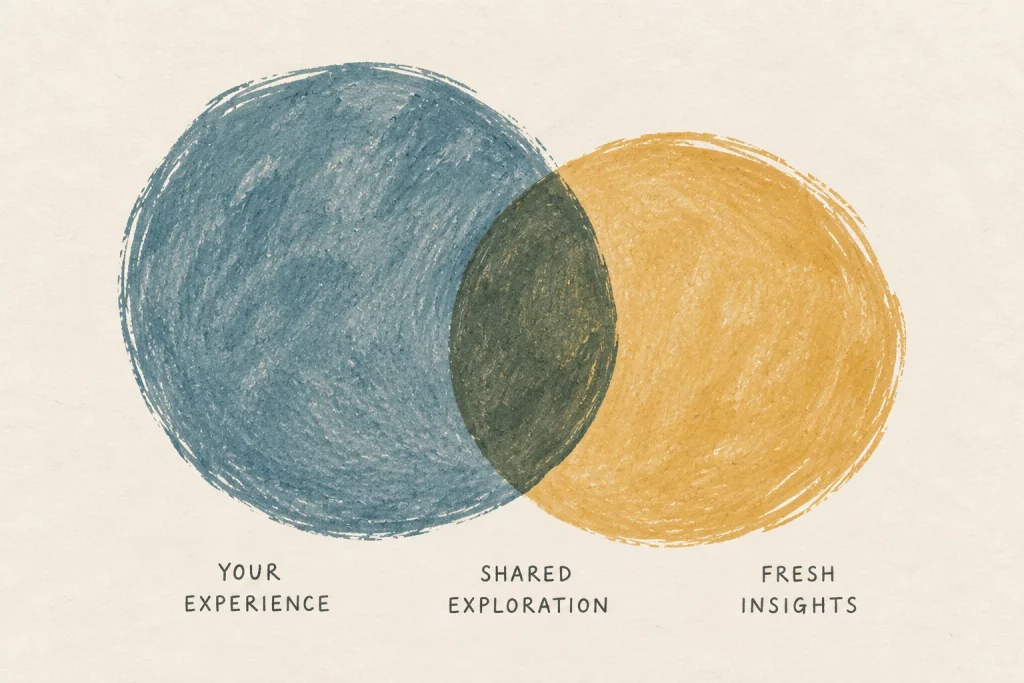
Understandably, therapists need other professionals to sit and think through these questions or challenges with them. Clinical supervision provides space for exactly this.
In our field, one of the spaces for this is clinical supervision.
| What does clinical supervision actually look like?
The word “supervision” can sometimes bring to mind checking, monitoring, or evaluating someone’s work. In psychotherapy practice, however, it means something different.
A supervision session is a space where a therapist can bring a case they have been thinking about, a difficult boundary situation, a point in the process that seems to keep repeating itself, a sense that something is not quite right but is difficult to name, or simply an interesting case they would like to explore and reflect on together.
A supervisor does not necessarily provide an answer or tell the therapist what to do in the next session. Sometimes the right question is more useful than advice.
Why does the therapist feel particularly guilty that progress has not been faster? Are they placing their own expectations onto the client? How might those expectations reflect other relationships in the client’s life? Why do they feel such a strong need to help the client change quickly? Why does one particular session leave them feeling helpless long after the client has left? Why is it difficult to stay focused with a particular client?
These questions do not only help us understand the client better. They can also open up what is happening within the therapeutic relationship itself.
| Therapists do not enter the room as a “blank slate”
Having proper trainings or many years of experience does not mean that therapists no longer have biases. They still are human with their own histories, emotions and sensitivity. These reactions do not automatically mean that the therapist is doing something wrong. In fact, they can sometimes provide useful information about what is happening in the session. What matters is whether the therapist notices these reactions and has enough distance to reflect on them before they begin to shape the way they work.
This is one of the reasons clinical supervision can be valuable.
| Some cases cannot be worked through simply by “trying harder”
Feeling stuck is a familiar experience in this work.
A client can show eagerness to learn, high engagement, and consistent participation. However, after several weeks or months, the therapist may begin to feel that both are circling around seemingly similar or even the same topic without any meaningful movements.
A common reflex is to learn new techniques, form better questions, or do more research. Somehow, a therapist can believe they are not yet successful because they are not doing enough. And sometimes that is true.
But sometimes the issue is not a lack of technique. The therapist may simply be too close to the process to notice something that is easier to see from the outside. A supervision session allows the work to be put down for a moment, looked at more slowly, and considered from another angle.
The question is not only:
“What should I do with this case?”
It might also be: What is happening between the two of us? Why has the process stopped here? What is the therapist trying to do, and is that what the client actually needs? Is the therapist trying to offer something they believe the client needs, rather than something the client genuinely needs? Has the therapist been still enough to listen to what is happening, rather than becoming preoccupied with techniques or with proving themselves?
Sometimes a simple question at the right time, with the right tone from supervisor can be very eye-opening.
| Experience does not make blind spots disappear
Clinical supervision is often talked about during training, but it is not only for people who are new to the profession.
A newer therapist may hesitate to bring a difficult case to supervision because they are afraid of being seen as lacking competence. A more experienced therapist may feel that, after a certain number of years, they should know what to do. But experience does not mean being able to see everything.
Someone may have worked for many years and then meet a client whose circumstances are very different from anything they have worked with before. An ethical issue may arise without a clear answer. Or a case may simply touch on something that the therapist cannot easily see in themselves.
Supervision, then, does not need to happen only when there is a problem. For many therapists, it is a regular part of practice: a place to keep reflecting on how they work.
Feeling uncertain, recognising the limits of one’s expertise, or noticing that there is something one does not yet understand does not mean that a therapist is incompetent. Recognising our own blind spots is also part of practising responsibly.
| Clinical supervision and personal therapy are not the same
Therapists may need both, but the two spaces serve different purposes.
In clinical supervision, the focus remains on the therapist’s work with clients. A supervisor may pay attention to the therapist’s feelings or personal experiences, but mainly to understand how these may be affecting the clinical work.
In personal therapy, the focus is on the therapist themselves and their own life.
Sometimes something comes up in supervision and the therapist realises that it belongs more to their own personal story than to the case being discussed. In that situation, personal therapy may be the more appropriate place to continue working with it.
| Clinical supervision in the context of practice in Vietnam
Not everyone practising in Vietnam comes to clinical supervision through the same route.
Some are introduced to supervision during their training. Some actively look for a supervisor when they begin seeing clients. Others only recognise the need for supervision after they have been practising for some time.
Finding the right supervisor is also not simply a matter of finding someone with more years of experience.
Therapists need to feel safe enough to speak honestly about their work — about the positive movement in a case, but also about the moments when they do not know what to do, a decision that later did not feel quite right, or questions they feel they should already know the answers to.
If someone in supervision constantly feels that they need to prove they are doing well, then that supervision is not really doing what it is meant to do.
A useful supervision space needs to be serious enough about the clinical work, while also being safe enough for a therapist to say, “I don’t understand, and I don’t know.”
| The person who listens also needs someone to think with
Much of the work that happens around a therapy session is invisible to the client.
It may involve reading more about a particular issue, reflecting on a recent session, consulting a colleague, or bringing a case to clinical supervision.
Supervision does not help therapists always arrive at the right answer. It gives them a space to keep asking questions about their work, even after many years in practice.
Some cases need more knowledge. Some need more time. And sometimes, what is needed is simply another person to look at what is happening alongside you.